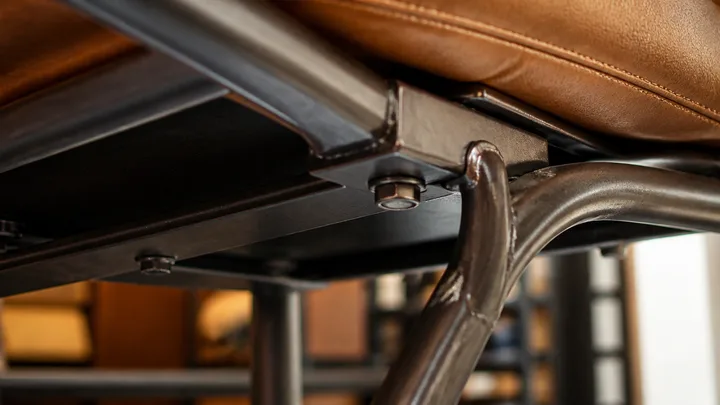
An easy-clean chair is one your staff can maintain with the approved products and a workable routine. Judge the completed chair: the seat, back, seams, frame, underside and floor-contact parts. A smooth seat or a “wipe clean” label leaves most of that routine unexamined.
Start with the problem in your dining room. Are crumbs difficult to reach, cleaning instructions missing, upholstery slow to dry, or chairs awkward to move? Use that problem to compare candidates rather than assuming one material category will solve every maintenance issue.
Follow the cleaning route around the chair
Inspect a sample from the seat to the floor. Look at the seat-back junction, piping, arm attachments, frame joints and underside. Note where debris can collect and whether staff can reach those areas using the method the maker allows.
| Part of the finished chair | Question for the supplier and cleaning team |
|---|---|
| Seat and back | Which instructions apply to the specified covering or exposed surface? |
| Seams and junctions | How are these areas accessed without prying apart or damaging components? |
| Loose or removable parts | Who may remove them, using which instructions and tools? |
| Frame and underside | How are exposed finishes and attachments cleaned? |
| Feet and glides | How are debris, wear and missing parts identified and addressed? |
A replaceable seat is useful only when the replacement and fitting method are supported. Ask for the part reference and who performs the work. Do not remove a pad or cover simply because it appears detachable.
Obtain instructions for each component

Ask for the exact model, frame finish and seat specification before collecting care documents. A textile instruction describes the textile; it does not automatically approve the same cleaner on painted metal, a wood frame, adhesives or a cushion's interior.
Herman Miller's Eames Molded Plastic Chair care sheet illustrates the distinction. It gives instructions for the plastic shell and wire or four-leg bases, with a separate routine for a wood dowel finish. A chair sold under one model name can therefore contain components needing different care. This example does not approve those methods for a chair from another maker.
Send the supplier your actual cleaning product names and current procedure. Ask for a written response covering the components in the quote. If a method conflicts with the furniture instructions, resolve it before ordering, with the people responsible for the restaurant's cleaning procedure.
Follow cleaner labels and the furniture instructions. Do not invent chemical mixtures, concentrations or a sanitation claim from a purchasing demonstration.
Include rinsing, drying and return to service
For an upholstered candidate, read beyond the initial stain-removal step. Ask what follows cleaning and how the chair is handled while the work is completed.
Sunbrella's indoor upholstery guidance includes rinsing and air drying. It also tells users to consult the furniture manufacturer before removing casings because cushion construction varies. Those details matter to the work required after a spill; they are instructions for the named application, rather than proof that every upholstered restaurant chair needs or tolerates that procedure.
Ask the supplier how the covering and completed cushion are maintained together. Identify any professional cleaning requirement, permitted removable parts and the instructions for returning the chair to use. If the restaurant lacks a suitable place for an approved process, consider another supported configuration or resolve the operating arrangement first.
Keep spare chairs and replacement components separate in the plan. A spare chair may keep a table usable while another is being maintained; an unfitted seat pad does a different job. Establish the actual storage and repair arrangement rather than adding a fixed percentage to every order.
Review ordinary handling with the staff

Have the people who reset and clean the dining room review the sample at the intended table. Check the normal route for moving it, cleaning beneath it and returning it to position. Note obstructions and awkward access without using the trial as a strength test.
If stacking is part of the routine, obtain the manufacturer's stacking method and limit for that model. A photograph of a stack does not establish how a different chair should be stored. Do not assume chairs may be balanced on tabletops or lifted using an attachment that was not designed for handling.
Check the specified glides against the floor and ask how replacements are identified. Refer a floor or handling concern to the responsible supplier or workplace reviewer rather than improvising a modification to the chair.
Run a bounded cleaning demonstration

Where a demonstration will answer a buying question, agree it with the supplier and sample owner first. Use the written instructions for the exact configuration. Protect surrounding components as directed and record the product and procedure used.
Observe the tasks: access, preparation, cleaning, any prescribed rinsing and drying, and restoring the chair to the room. Record specific difficulties, such as an inaccessible junction or an instruction requiring equipment staff do not have. If measuring staff time, state the tasks included and conditions observed; a single demonstration cannot establish long-term labor savings.
Do not deliberately soil or damage a returnable sample without permission. A successful demonstration is evidence about that procedure on that sample, not a certification of hygiene, a stain-proof promise or a lifespan test.
Approve the chair and its operating routine together
Keep model, covering code, frame finish, care documents, supported service parts and sample findings with the accepted quotation. Mark outstanding instructions or compatibility questions as pending. A supplier substitution in the seat or finish needs its own review even if the chair looks similar.
For an existing stock problem, use the replacement-chair guide to decide what remains in service. The sample guide covers the arrangements for obtaining and returning the trial piece.
Add the accepted chair and care requirements to the furniture planner. Use the indoor furniture overview when comparing a different construction. The result should name a chair your team can maintain and explain the routine it has agreed to carry out.