Put high chairs on their own line in the furniture order. They need different product documentation, a place at the dining tables and a routine for returning each one clean and ready for use. Choosing an adult dining chair does not answer those questions.
Start with how the restaurant intends to serve families. Identify the tables where a high chair can be placed within the reviewed dining layout, where staff retrieve it and where it goes after use. Keep the child's dining position in the layout review; a high chair should not become an extra place squeezed into a service route.
Obtain the high-chair documents before comparing styles
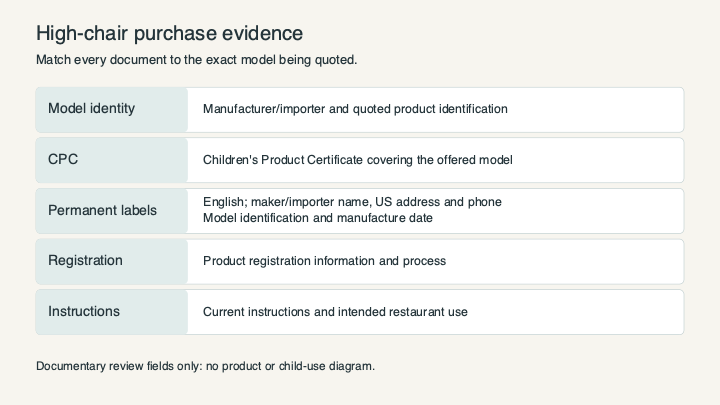
For a US project, use the CPSC's high-chair business guidance as the starting point. It identifies 16 CFR part 1231 and the incorporated high-chair standard. It also explains that manufacturers and importers issue a Children's Product Certificate for products subject to the relevant requirements.
Ask the seller for the certificate covering the offered model, the current instructions and the manufacturer's confirmation of the intended restaurant use. Match the identification on the documents to the product being quoted. A general adult-chair test reference or the word “commercial” is not a substitute for high-chair documentation. The commercial seating guide addresses the adult chairs separately.
CPSC also identifies permanent labels in English with the manufacturer or importer's name, US address and phone number, model identification and manufacture date, together with product registration requirements. Keep that information with the purchase record and follow the product's registration process so the restaurant can receive recall information. If sourcing an older or second-hand model, resolve its identity, instructions, condition and recall status before considering it for use.
Check the chair at the tables you will use
Request the complete footprint, seat and overall heights, operating instructions and any tray options. Compare the chair with the actual table top, apron and base. An overall height on a spec sheet does not tell you whether the seat can approach a particular table without interference.
Arrange an unoccupied sample with the table and neighboring chairs. Check its intended dining position, the room around it and the staff approach. For a folding product, follow the maker's opening and locking instructions. For a product intended to stack, obtain the permitted stack and handling method. Do not infer either feature from a similar-looking model.
Koala Kare's KB615 page describes a folding high chair whose seat and legs lock when opened. That is one storage arrangement to investigate, not a specification for every restaurant high chair. Ask for the offered model's open and stored dimensions and check the actual storage location.
Treat a tray or other accessory as a separate configuration question. Confirm whether it is supplied, which model it fits and how it affects the dining position, cleaning and storage. A high chair and a booster seat are different products; specify the product intended for the child and use described in the manufacturer's instructions.
Make the return routine part of the selection
Have the person responsible for dining-room care review the exact instructions before purchase. Can staff reach the seat joints, straps, buckle and other surfaces that need attention? Where does a used chair wait while it is cleaned, and where does a ready chair belong?
Use the maker's cleaning and inspection requirements. For example, the KB615 instructions address the restraint, warning label, attachments and locked opening position, and prohibit bleach for that product. Do not transfer a cleaning method from the restaurant's adult chairs to a high chair without confirming compatibility.
Keep the operating instructions available to staff. The same KB615 document calls for children to be capable of sitting upright unassisted, restraints to be used and an adult to stay near and watch the child. Follow the selected product's own suitability limits and supervision instructions rather than turning one model's guidance into a rule for all child seating.
Decide how staff identify a chair with a missing part, damaged restraint or other unresolved problem and keep it out of the ready stock. Ask who supplies the correct replacement parts and instructions. An unapproved substitute strap does not resolve an identified product problem.
Order for usable stock, then keep a record
For an existing restaurant, record high chairs issued at the same time, occasions when demand could not be met and pieces unavailable for cleaning or repair. For an opening, label the starting quantity as a planning choice and set a review after service begins. Neither total restaurant seats nor a generic percentage establishes the right stock quantity.
Keep this small purchasing record:
| Record | What to confirm |
|---|---|
| Model and documentation | Product identification, certificate, intended use and current instructions |
| Table placement | Reviewed locations with the actual table and adjacent furniture |
| Storage | Open and stored dimensions, permitted handling and assigned location |
| Care and support | Cleaning method, inspection routine and correct service parts |
| Quantity | Ready stock needed, separately identified unavailable pieces and any approved extras |
When asking for help with a family-dining furniture project, describe the high-chair requirement separately in the restaurant furniture inquiry. Ask whether a suitable documented model can be supplied; availability remains to be confirmed. Include the tables and adult seating in the same project description so the supplier can see the full arrangement, while keeping each product's requirements clear.