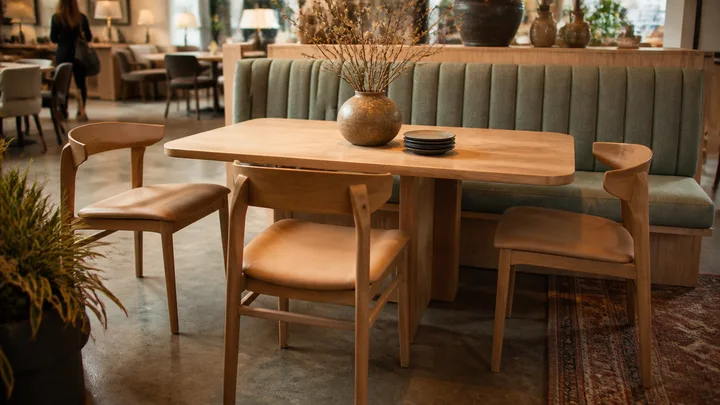
Choose between quoted constructions, not between two finish photographs. A wood-grain laminate, a wood veneer and a solid wood top can look similar while requiring different care and repair decisions. The useful comparison identifies the surface, the material beneath it, the edge and the finish your staff will maintain.
Start with the service you run. Bring your ordinary cleaning products, tableware and spill routine into the discussion, then ask each supplier to explain how its proposed top accommodates them. Neither “commercial laminate” nor “natural wood” settles that question on its own.
Identify what the quote actually includes
Ask the supplier to describe the complete top in writing. Keep the following distinctions visible on the comparison sheet.
| Quoted construction | Information still needed |
|---|---|
| Laminate over a core | Named surfacing product, core, thickness, edge construction and underside treatment |
| Solid wood | Species, construction, finished thickness, coating or oil system and care instructions |
| Wood veneer over a core | Veneer and core specification, edge detail, finish and supported repair method |
“Oak finish” might describe a color, a printed pattern or actual oak. Ask which it means. Likewise, “laminate” does not identify the particular surfacing product or explain how the fabricated edge is finished.
Record the fabricator as well as the surface manufacturer. The fabricator supplies the completed top, including its edge and attachments; a surface-maker's care sheet does not answer every question about that assembly.
Compare the care your team can carry out
Formica's care guidance gives a useful example for its brand products: a damp nonabrasive cloth and mild cleaner, followed by rinsing and drying. It specifically warns against flooding laminate near seams because water can enter and swell the substrate. That warning makes the fabricated edge worth discussing, even when the broad face looks straightforward to wipe.
Ask how the exact top is cleaned at the end of service and between guests. Send the names of your cleaners and the method staff use; do not treat a general “wipe clean” answer as approval for every chemical, concentration or cleaning tool. Obtain instructions for any distinct edge material too.
Wood needs the same product-specific approach. Herman Miller's wood and veneer instructions separate its regular wood finishes from identified oiled veneer products. The maintenance and repair guidance differs. This is an example of why a finish system matters, rather than a recommendation to use those furniture-care methods on another manufacturer's restaurant table.
Have the supplier identify what your top requires, what it prohibits and who handles more involved maintenance. A daily routine staff cannot realistically follow remains an unresolved buying issue, however attractive the sample.
Inspect an edge, not only a swatch

Request a fabricated sample or a complete top showing the edge being quoted. A loose laminate sheet or small wood swatch cannot demonstrate a rounded corner, edge joint or attachment on the finished piece.
Look at where the face meets the edge and where the edge meets the underside. Ask what is sealed, how exposed material is protected and how any joint should be cleaned. For veneer, ask whether the edge is veneered, solid wood or another material. For solid wood, ask how the finished edge is maintained.
Use the sample to settle shape and handling too. Check whether the corner and profile suit people passing the table and whether the edge works when tables are placed together. Record the accepted detail rather than leaving “rounded edge” open to interpretation.
Separate appearance from a repair promise
Do not assume a scratched wood top can always be sanded back or a damaged laminate top can always be patched invisibly. Ask about the particular construction and finish. Herman Miller's veneer guidance cautions against sanding through veneer during repairs, illustrating why solid wood and a thin wood surface need different answers.
For each candidate, request a supported response to the damage you are trying to avoid: a chipped edge, a marked surface or water entering a joint. Ask whether the response is a finish repair, an edge replacement, professional refinishing or replacement of the top. Establish who performs it and how a repaired piece is returned to service.
Keep warranty terms separate from repair availability. A supplier offering a repair service has not necessarily promised to cover every cause of damage, and an available touch-up product does not establish an invisible result.
Review the finish in the actual dining room

Compare your shortlisted surfaces with the retained furniture and the lighting used during service. Ask what a sample represents: color, sheen, texture, grain or a combination of those features. Identify anything the sample does not show.
For wood, ask how natural variation will be described and accepted. For a patterned surface, ask how pattern direction is arranged on different sizes of top. A screen image cannot settle either question for an order.
Use the finish-coordination guide for the wider palette. Here the decision is narrower: which specified top construction and finish will be ordered for each table type.
Finish with a comparable specification

Compare quotations for the same shape, dimensions, thickness, edge, finish, quantity and delivery scope. Identify the complete top weight and have the proposed top-and-base assembly approved by its supplier. Material selection does not establish base compatibility.
If retaining bases, use the replacement-top guide to identify and assess them. Use the sample guide to arrange any outstanding physical review.
In the furniture planner, record the selected construction, named finish or surface code, edge detail, care instructions and sample reference against each table type. Keep unanswered compatibility or repair questions visible. If the supplier substitutes the core, finish or edge, reopen the relevant decision before accepting the change.